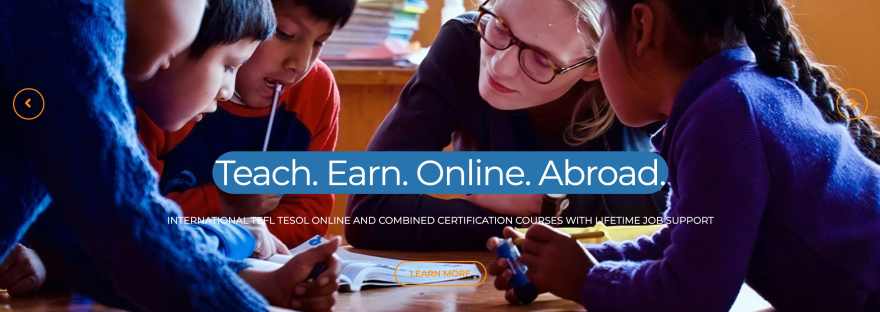

Image of a TEFL Online Pro graduate teaching English to children
tefl online pro, tefl online pro reviews, TEFL/TESOL Travel

What Can You Do With a TEFL Certificate from TEFL Online Pro? (2026 Guide)

A TEFL certificate from TEFL Online Pro is an internationally recognized qualification that prepares you to teach English online or abroad in countries around the world.

Our courses are fully accredited by ACTEFLC and designed to provide practical training in lesson planning, classroom management, grammar teaching, and real-world teaching scenarios.

A TEFL Online Pro graduate teaching English online

Teach English online

Many TEFL Online Pro graduates begin their teaching careers online, working with students worldwide from home or while traveling.

Our courses include dedicated training in TEFL employment, resume/CV preparation, and interview techniques to help you transition into teaching roles after certification.

Online teaching typically includes:

  • One-to-one English lessons
  • Conversation practice
  • Business and general English tutoring

Teach abroad in language schools

TEFL Online Pro graduates go on to teach in private language schools across regions such as Asia, the Middle East, Latin America, and Europe.

Our training prepares you for real classroom environments, including:

  • Lesson planning and structure
  • Classroom management techniques
  • Teaching speaking, listening, grammar, and pronunciation

International schools, universities, and further progression

It is also possible for TEFL Online Pro graduates to secure roles in international schools and higher education institutions as part of their teaching career path.

For those who wish to further develop their qualifications, some teachers choose to progress onto advanced training such as the DELTA (Diploma in Teaching English to Speakers of Other Languages), which is designed for experienced teachers who want to specialize further or move into teacher training roles.

TEFL certification provides the foundation for a long-term career in English language teaching, with opportunities to grow into more advanced positions over time.

Private tutoring and freelance teaching

Another common path is private tutoring, either online or in person.

This allows graduates to:

  • Work independently with students
  • Focus on specific learning needs
  • Combine tutoring with online or classroom teaching

TEFL Online Pro course options

TEFL Online Pro offers three internationally recognized certification pathways:

60-Hour Fast-Track Course | Designed for those with prior experience | https://teflonlinepro.com/60-hour-fast-track/

120-Hour Professional Course | Designed for beginners with little or no experience | https://teflonlinepro.com/120-hour-professional/

140-Hour Hybrid Course | Includes online study plus teaching practice | https://teflonlinepro.com/140-hour-hybrid/

All courses are self-paced with tutor support and lead to internationally recognized certification.


Do you need experience?

No prior teaching experience is required to enroll in the 120-Hour Professional Course or the 140-Hour Hybrid Course. These programs are designed for complete beginners and guide you step by step through the skills needed to start teaching confidently.

The 60-Hour Fast-Track Course is designed for candidates who already have some teaching experience or a strong foundation in English language teaching.

Graduate outcomes

TEFL Online Pro graduates go on to teach English online and in classrooms around the world, including through language schools, private tutoring, and international teaching roles.

To learn more about student experiences and outcomes, you can explore feedback from past graduates below:

Trusted TEFL Reviews: https://trustedteflreviews.com/category/tefl-online-pro-reviews-in-2025/

YouTubehttps://www.youtube.com/@teflonlinepro

Facebookhttps://www.facebook.com/teflonlinepro/reviews

Googlehttps://g.page/r/CWQMRorxD2gfEAI/review

Featured by Cambodia Bucket Listhttps://cambodiabucketlist.com/tefl-online-pro-reviews/

TEFL Online Pro also provides structured post-course support to help graduates transition into teaching roles after certification.


Start your TEFL journey

If you are considering teaching English abroad or online, a TEFL Online Pro certification provides the training and support needed to begin your teaching career and access opportunities worldwide.

Ready to get TEFL certified?

Take the next step and enroll in a TEFL Online Pro course today:

https://teflonlinepro.com/enroll/

Flying overseas for a teaching English abroad job.
TEFL/TESOL Travel

7 TEFL/TESOL Essential Tips For Flying Overseas

7 TEFL/TESOL essential tips for flying overseas


These 7 tips will help make your journey run smoother – whether you are making the trip abroad for a teaching English position, or just for a getaway break.


1. Buy health and travel insurance before you set off.

This should really be a no-brainer, but you would be surprised by just how many people head off abroad without comprehensive health and travel insurance. Some banks offer insurance when you take out a bank card with them, so this might also be worth checking out.

Due to the current complications within the airline industry, caused by the COVID-19 pandemic, we strongly recommend buying travel insurance that covers cancelled flights. If you take a look at https://www.airlinequality.com, you can read the many angry complaints from customers who have had their flights cancelled last minute. A significant number of flyers have complained about not being able to get through to an airline’s customer support, complained about being offered vouchers instead of a cash refund, and complained that their flight was cancelled a few days before their scheduled date of departure. A good travel insurance policy should cover you if you find yourself in a similar situation.


2. Do something nice for your future self and choose a great seat.

The best seats on an aeroplane.
Not all airline seats are created equal.

When you have paid for your flight, you are then usually directed to choose your seat.

We recommend checking which type of plane you will be flying on, and then going to https://www.seatguru.com to take a look at which seats are recommended for your flight – and which seats are best avoided. As a general rule, the most uncomfortable seats on a plane are the ones located next to the toilets, middle seats, and the seats in the last row of the aircraft.

A lot of people prefer being located over the wing as this makes for a smoother ride. Sitting at the back of the plane will mean experiencing more turbulence. However, in the (extremely unlikely) event of an unplanned landing at high speed, the back of the plane is statistically where you will have the greater chance of surviving.


3. Prepare yourself for the highly improbable.

Modern-day airline travel is one of the safest forms of travel.

According to 2015 statistics from The Economist, the probability of your plane going down is around one in 5.4 million. In fact, air travel is (by far) the safest form of transport around. It is, however, prudent (and polite) to pay attention to the pre-flight safety demonstration. And it is also wise to take a read through the aircraft safety card.

When a plane disaster does happen, it is the passengers who paid attention to the safety instructions that are more likely to survive. Examples of completely avoidable deaths when a plane did run into problems were passengers inflating their life vests inside of the plane, and passengers who couldn’t work out how to unbuckle the seat belt – both examples having been explained in the pre-flight safety instructions.

Another good tip regarding safety on board, is to count the rows of seats from the nearest exit as you make your way up the aeroplane aisle. This way, you will be able to make your way safely out of the plane in that rare event of a total blackout on board.


4. Don’t get juiced up on alcoholic drinks.

One alcoholic drink in the air is equal to two on the ground.

Because a lot of people are nervous flyers, they tend to rely on alcohol to calm themselves when flying.

If you do need to drink, we recommend just having the one. Well, perhaps two is also fine ๐Ÿ™‚ One thing you really don’t want to do though is to drink more than two, because then you will arrive at your destination feeling pretty dreadful.

There is a saying that ‘one drink in the air is two on the ground’ – meaning that you’ll experience an alcohol double-whammy when you have a drink on the plane. Flying at high altitudes also dehydrates the body, so alcohol is really best avoided completely.

Our advise for any nervous flyers out there, is to contact your doctor and ask them for a one-time prescription of valium. Taking one valium tablet before your light will help with the flying nerves and you won’t feel so terrible when you have arrived at your destination.

But, NEVER mix the medication with alcohol!


5. Be nice to the flight attendants.

The job of a flight attendant can be extremely stressful.

A lot of people seem to quite naturally assume that flight attendants live the glamorous life of international travel, 5-star hotels, and high salaries.

The reality, however, is that the job of a flight attendant is more often than not excessively demanding. The salaries are relatively low, there is often very little time for sleep once the plane has landed and a long journey home has been spent pondering a next-day early morning departure, and some flyers can be less than pleasant. On top of all this, flight attendants are expected to look their best at all times on board, and are expected to be alert and approachable throughout the flight.

When you first board your plane, we recommend giving the flight attendants a friendly smile and saying ‘hello’ to them. Continue this respectful behaviour on board and you will find that they will be much more ready to help you out with any questions or requests that you might have during the flight. And besides, it feels good to make someone else feel good too ๐Ÿ™‚


6. Mid-flight theft is a thing.

Theft from airline passengers is on the increase.

A lot of people board the plane, place their belongings in the overhead compartment (the bag or case which was too valuable to place in the hold) and then promptly forget about it until the plane arrives at their destination.

In an ideal world, this is perfectly acceptable behaviour.

Unfortunately, this isn’t an ideal world.

Some individuals take flights for the specific purpose of stealing valuables from unsuspecting travellers.

Our advice, is to keep your money and passport stashed inside a money belt – concealed under your clothing. If your carry-on luggage isn’t too cumbersome then store it under the seat in front of you. If it has zippers, consider buying a combination lock so that you can sleep with the knowledge that no stray hands will be able to open it while you are sleeping to the white noise of the plane’s engines.

If you have to place your carry-on in the overhead lockers, make sure that you are aware of exactly where it is – flight attendants sometimes move overhead cabin luggage before takeoff, in order to better organise space.

Either way, don’t assume that all of your fellow passengers are making the journey with you purely for transport reasons.


7. Fill out the arrivals card before your plane lands.

The inconvenience of arrivals card are often confounded by a lack of available pens.

Towards the end of long-haul flights, it is often the case that you will be given an arrivals card to complete before you can pass though immigration.

Towards the end of long-haul flights, people are often tired and put off completing the card until they have reached passport control. This is when they realise that they don’t have a pen, there isn’t a pen in sight, and they probably don’t have their flight ticket stub either and so can’t remember their flight number.

To avoid this unnecessary stress, we recommend completing the arrivals card while you are still on the plane. If you don’t have a pen, you can always ask the flight attendant whom you have been polite to throughout the flight and they will likely find a pen for you.

With your arrivals card complete, you can safely stash your passport back under your clothes and walk off the plane prepared to join the immigration queue – all your documents at the ready.

TEFL Online Pro wishes you all a Bon voyage! ๐Ÿ™‚

Where will you teach English?

For any unanswered questions, contact us via the TEFL Online Pro official school website: https://teflonlinepro.com/contact-us/

Thank you for reading thisย 7 TEFL/TESOL Essential Tips For Flying Overseasย article.

Paul Murphy | Operations Manager | TEFL Online Pro

https://teflonlinepro.com/enroll/

https://www.facebook.com/teflonlinepro/reviews/

https://www.youtube.com/@teflonlinepro

The Teachersโ€™ Choice Award winner in 2019, 2020, 2021, and 2022

https://trustedteflreviews.com/category/tefl-online-pro-teachers-choice-award-winner-2022/


TEFL Online Pro official website homepage in 2026 for the official TEFL Online Pro Reviews website
tefl online pro reviews

Teach.

TEFL Online Pro. Teach.


As an English speaker, born into one of the de facto native English nations (Australia, Canada, Ireland, New Zealand, South Africa, United Kingdom, and the United States of America) there are very few barriers for you to freely teach English around the planet, in the global locations where English tuition is sought after in high demand – which is pretty much anywhere in the world, with the exception of Antarctica.

But let’s all leave the Earth’s southernmost continent alone, even if a burgeoning TEFL industry were to be one day considered there too.

Such is the international demand for learning the English language, that non-native English speakers also experience little difficulty in securing English teaching positions overseas – as long as their English language level is at C1 or C2 semi-fluency/fluency level.

Of course, the native English speakers will have the pick of the jobs first, but there are so many opportunities that our non-native English speaking graduates also successfully interview for teaching English jobs worldwide.

Many people choose to teach English overseas as a Gap year, some choose it as a way of taking a few years “off” while they go explore the world, and there is a growing trend for Baby boomers, and people born into the Silent Generation and Generation X, to use their TEFL/TESOL credentials in order to be able to live overseas; often teaching under tamarind-tree shaded sunlight and spending a portion of their disposable income on coconut oil massages and coconut water health drinks.

And then, of course, there are the migrating humans, that spend the summer months back home and who then fly to a much warmer part of the world to teach English when the first flakes of winter snow arrive.

It isn’t all champagne and caviar though.

Teaching English can be an incredibly demanding job.

Students often have the superpower of zapping energy from you like crystalline Kryptonite. Your days might be long. You might nurture dark thoughts towards particular students, and one or two will inevitably be mirroring your exact same excursions of the mind.

But, overall, you will – in the vast majority of cases – complete that class semester that occasionally drove you nuts, and you will miss those moments in your life when you found yourself reaching out to other human beings and sharing your knowledge; to people whose future quality of life, very likely, partly depended on their attendance at your English classes.

So yes, as with any job there are pros and cons.

But regarding teaching English, who else do you know that can honestly state that they work a 4-day week and are then able to spend a long weekend off on an exotic island, such as (for example) Koh Rong in southern Cambodia?

If you are reading this and suddenly feel that ‘itchy feet’ syndrome of wanting to get the hell out of where you are living and traveling the world, you can! ๐Ÿ™‚

Or, if you would like to stay put for a while and earn money teaching English online, we have now also become experts in the field of helping to connect TEFL Online Pro graduates with high-paying online teaching employment, through our meticulous researching of online language schools.


Where will you teach English?

For any unanswered questions, contact us via the TEFL Online Pro official school website: https://teflonlinepro.com/contact-us/

Thank you for reading this TEFL Online Pro. Teach. article.

Paul Murphy | Operations Manager | TEFL Online Pro

https://teflonlinepro.com/enroll/

https://www.facebook.com/teflonlinepro/reviews/

https://www.youtube.com/@teflonlinepro

The Teachersโ€™ Choice Award winner in 2019, 2020, 2021, 2022, 2023, 2024, and 2025

https://trustedteflreviews.com/category/tefl-online-pro-reviews-in-2025/


TEFL Online Pro Reviews home page image 3.
tefl online pro reviews

Earn.

TEFL Online Pro. Earn.


No matter where you decide to teach English, you can be rest assured that you will always be guaranteed to earn an above average local salary.

In life, everything tends to be relative.

Please allow us to use the Big Mac Index as a variable of this relativity, to compare two teaching English locations: Switzerland and the Czech Republic.

In Switzerland, you can earn between US$30 to US$60 per hour teaching English. The average price of a Big Mac in Switzerland, according to the 2020 Big Mac Index, is US$6.71.

In the Czech Republic (Czechia) most teachers start off on a US$15 to US$20 hourly rate, although some diligent teachers, who hit the ground running at Vaclav Havel International Airport, have been known to earn up to US$50 per hour. But in realistic terms, starting out as an English teacher in the Czech Republic, the US$15 to US$20 hourly rate is a more helpful indicator for you. The average price of a Big Mac in the Czech Republic, according to the 2020 Big Mac Index, is US$3.76.

At this stage of the article, we want to sincerely apologize to our vegan and vegetarian customers and graduates. We decided to us the Big Mac Index simply because it’s just so useful in the measurement of purchasing power parity.

Explained in basic economics, if you choose to teach English in an expensive country, you will earn a higher salary and incur higher daily costs. If, however, you choose to teach English in an inexpensive country, you will earn a lower salary and incur lower daily costs.

We have tefl online pro graduates, for example, teaching English in Prague. They tend to work the same amount of hours per month. Most of them get by on a hedonistic lifestyle that some Czechs could only dream of aspiring. These teachers tend to spend their disposable income on lots of “me time” ๐Ÿ™‚ And why not? It’s an amazing city and there are lots of bars, restaurants, theatre performances, etc., to spend money on. Some teachers, however, are much more prudent with their salaries and use their saved income to travel to warmer destinations in the winter holidays and for backpacking adventures in the long summer holiday months. And some teachers religiously save whatever they earn, to help pay off their student loan, and to have money in the bank when they either return back home or head off on their next teaching English abroad adventure.

The alternative, of course, is to teach English (from home) online. Hourly wages vary tremendously, but tefl online pro has an excellent network of online language schools that pay between US$20 and US$35 per hour. Not so bad, considering you save money on transport and time and you have that precious, sought after, ideal lifestyle of making money online.

So wherever (or however) you choose to teach English, your ability to save money won’t necessarily depend on how much you earn. We have examples of tefl online pro graduates who have gone off to South Korea to teach, and who have then returned home and been able to afford to put down a deposit on a mortgage. We also have graduates who choose not to save at all. And then there are the graduates that combine the two, by leading an active social life and still managing to put aside a sizeable chunk of their earnings each month.


Where will you teach English?

For any unanswered questions, contact us via the TEFL Online Pro official school website: https://teflonlinepro.com/contact-us/

Thank you for reading this TEFL Online Pro. Earn. article.

Paul Murphy | Operations Manager | TEFL Online Pro

https://teflonlinepro.com/enroll/

https://www.facebook.com/teflonlinepro/reviews/

https://www.youtube.com/@teflonlinepro

The Teachersโ€™ Choice Award winner in 2019, 2020, 2021, 2022, 2023, 2024, and 2025

https://trustedteflreviews.com/category/tefl-online-pro-reviews-in-2025/